


How to Identify & Date Vintage Ercol Furniture
A missing label doesn't mean a piece isn't genuine Ercol. It's one of the most common worries we hear in our Doncaster showroom, and it's usually unfounded — labels come loose, get polished away, or simply weren't fitted consistently at the factory. The good news is that a label is only one of several ways to identify and date a piece. Construction, timber and model number all tell the same story, and once you know what to look for, you can read them with confidence.
We've stocked genuine Ercol furniture across our three-storey Doncaster showroom for over 105 years, and our non-commissioned team spends a good part of most weeks talking customers through exactly this kind of question. This guide walks through every marker Ercol has used since 1920, in the order we'd check them ourselves.
Table of Contents [Hide]
- Ercol's History, in Brief
- What Ercol Labels Look Like and Where to Find Them
- Dating Ercol Furniture by Label Era
- Dating Ercol Furniture by Model Number and Range
- Timber and Construction Details That Confirm Authenticity
- What a Missing Label Does and Does Not Tell You
- Spotting Reproductions and Later Pieces
- Common Misconceptions About Ercol Labels
- Conclusion
- FAQs
Ercol's History, in Brief
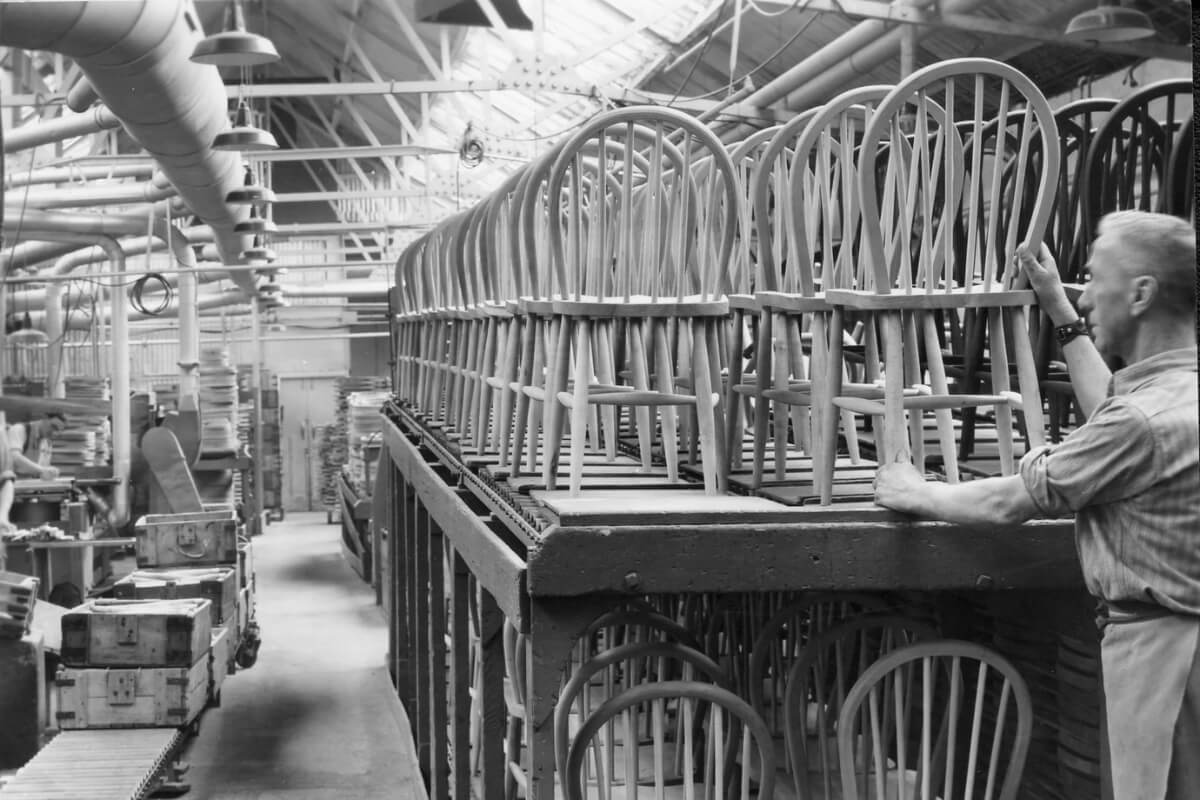
Lucian Ercolani founded the company in High Wycombe in 1920, originally trading as Furniture Industries Limited before adopting the Ercol name a little later. The firm made its reputation on steam-bent elm and beech furniture, and its best-known piece, the Windsor chair, launched at the Furniture Exhibition at Earl's Court in 1950. It has stayed in continuous production ever since, which matters before you start dating a piece — the range itself hasn't gone anywhere, even though individual labels, finishes and materials have changed several times over the decades.
What Ercol Labels Look Like and Where to Find Them
Ercol has marked its furniture in three main ways since 1920: paper labels, metal badges, and — on some upholstered pieces — woven fabric labels. Each belongs to a different era, so knowing which type you're looking at gets you most of the way to a date before you check anything else.
Paper Labels
Early and mid-century Ercol furniture typically carries small metallic paper labels, usually blue or gold, printed with the company name. You'll find them on the underside of chair seats, beneath tabletops, on the back rail of cabinets, or inside drawers. Because they're paper, decades of handling, polishing and the odd re-upholstery job take their toll — a worn or partially illegible label is completely normal on a piece this age, and doesn't say anything about whether the piece is genuine.
Metal Badges
From the mid-1990s onwards, Ercol moved to small metal badges recessed into the wood rather than paper labels. Early versions used a tree motif before switching to text badges reading "ERCOL" and, later, the lowercase "ercol" branding still used today. These sit flush with the surface and hold up far better than paper over time, which is part of why they became the standard.
Woven Fabric Labels
On some upholstered pieces — sofas and armchairs in particular — you'll find a woven fabric label sewn into a seam or attached to the frame underneath. These turn up less often than paper or metal markers, but where they survive they're a useful secondary check alongside the frame construction itself.
Dating Ercol Furniture by Label Era
Once you've identified which type of label your piece carries, you can narrow the date considerably.
| Label Type | Approximate Period | What to Look For |
|---|---|---|
| Blue paper label | Mid-1950s to mid-1970s | Blue and metallic gold printing, usually reading "Made in England" |
| Gold paper label | Late 1970s to mid-1990s | Gold metallic printing, sometimes including a model or design reference |
| Metal tree badge | Mid to late 1990s | Small recessed metal badge with a tree motif |
| Metal text badge | 2000s onwards | Recessed metal badge reading "ERCOL" or "ercol" |
These date ranges are well established among collectors and restorers, though the exact cut-off years vary slightly depending on the source, since Ercol phased changes in gradually rather than switching overnight across every range at once. Treat them as a reliable window rather than an exact year, and use them alongside model number and construction for the most accurate picture.
Dating Ercol Furniture by Model Number and Range
Every Ercol design carries a model number, and cross-referencing that number against the range it belongs to is often more precise than the label alone. Ercol keeps a catalogue archive covering decades of production on its own website, which is the most reliable place to confirm a range's original run and specification.
If your piece carries a label, the model number usually appears alongside it. If the label is missing, the number is sometimes stamped directly into the timber underneath the seat or on a structural rail — check with good light before you rule it out.
Timber and Construction Details That Confirm Authenticity
When a label is missing or too worn to read, construction tells you almost everything the label would have.
Ercol's early and mid-century furniture combined elm for shaped, load-bearing parts like seats with beech for straighter structural elements such as legs and frames — elm's interlocking grain made it well suited to steam-bending and resisted splitting under weight. Windsor chairs today are made entirely from solid ash, so the timber alone can be a useful clue to roughly which era a piece belongs to.
The joinery is just as telling. Ercol's signature wedge joint sees a chair leg pass through the seat and get fixed in place with a small wedge of contrasting timber, glued rather than screwed or nailed. Look underneath the seat and you'll see this as a neat, close-fitting circle where the wedge meets the leg — a detail that's genuinely difficult to replicate convincingly, and one of the clearest tells between a genuine piece and a look-alike.
What a Missing Label Does and Does Not Tell You
To put it plainly: an absent label tells you the label is gone, nothing more. It says nothing about the quality, age or authenticity of the piece underneath it.
Labels detach for entirely mundane reasons — a re-upholstery job, decades of cleaning, general handling, or simply age weakening the adhesive. None of that affects the construction, the timber, or the joinery, which is exactly why we always look at more than one marker before forming a view on a piece. If the label's gone, the wedge joints, timber and model number (where it's stamped into the frame) usually fill in the gap.
Spotting Reproductions and Later Pieces
Because genuine Ercol construction is distinctive, reproductions and look-alikes tend to fall down on the details rather than the overall shape. Squared or oval spindles where they should be round, joints without the wedge detail, or timber that doesn't match the grain and colour of elm, beech or ash are the most common giveaways.
If you're buying secondhand, whether from a private sale or an online listing, check construction details in person wherever possible rather than relying on photos alone. Sellers don't always misrepresent furniture deliberately — Ercol-style pieces from other makers get mistaken for the real thing fairly often, simply because the silhouette is so well known.
Common Misconceptions About Ercol Labels
A few myths come up often enough that they're worth addressing directly. The first is that "Blue Label" refers to a specific range or collection — it doesn't; take a look through our current Ercol collection and you'll see how many different ranges share the same label era. Blue labels mark an era of production, not a design line, and plenty of different Windsor-era pieces carry them. The second is that a missing label automatically means a piece isn't genuine, which — as above — simply isn't the case. And the third is that any spindle-back chair in a similar style must be Ercol; shape alone proves nothing without the construction details to back it up.
Conclusion
Identifying and dating vintage Ercol furniture comes down to reading several markers together rather than relying on any single one: the label type and era, the model number where you can find it, and the timber and joinery underneath. A missing label should never be the end of the conversation — the construction usually tells you what you need to know.
If you'd like a second opinion on a piece, or you're after a genuine Ercol range for your own home, our team is always happy to talk it through with no pressure either way. Visit our Doncaster showroom or browse our current Ercol collection at wardbrothers.co.uk.
FAQs
How can I tell if a piece of Ercol furniture is genuine? Start with the label if there is one, then check the construction. Genuine pieces use Ercol's signature wedge joint at the leg-to-seat junction, and the timber will be elm, beech or ash depending on the era. Construction is the most reliable check when a label is missing or unreadable.
Does every vintage Ercol piece have a label? Most do, but not universally — labelling wasn't applied with perfect consistency, and paper labels in particular are easily lost over sixty-plus years. An absent label is common and doesn't indicate a problem with the piece.
Can I date a piece without a label at all? Yes. Timber type, joinery and, where it's stamped into the frame, the model number will usually get you a reliable date range even without a label to go on.
Is the Windsor range still made today? Yes — the Windsor chair has been in continuous production since it launched in 1950, so "Windsor" on its own doesn't tell you whether a piece is vintage or current. Label type and construction detail are what narrow that down.
-
Posted in
Ercol, Model Numbers, Product Identification, Vintage